Industrial Steel Warehouse Design Guide: Build Around Workflow, Not Just Square Meters
Introduction
An industrial steel warehouse is more than a storage shell. For manufacturers, logistics companies, agricultural processors, distributors, and industrial park developers, the warehouse often determines how efficiently goods move, how safely people work, how easily equipment is installed, and how quickly the business can expand.
Many buyers start with a simple request: length, width, height, and roof type. But a warehouse that looks correct on paper can still create daily problems if the clear height is too low, the column grid conflicts with racking, the loading dock blocks truck flow, or the roof and wall system cannot handle the local climate.
A better approach is to design the warehouse from the inside out. Start with operations, then build the steel structure around the workflow.
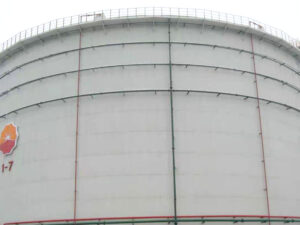
Shandong No.7 Construction provides integrated steel structure solutions for industrial warehouses, workshops, logistics facilities, commercial buildings, and large-span projects. The company’s website highlights steel structures, steel buildings, storage tanks, gas station construction, space frames, and steel truss structures as key product directions.
Why Industrial Steel Warehouse Planning Should Start with Operations
The biggest mistake in warehouse planning is treating the building area as the main design target. Area matters, but usable efficiency matters more.
A 10,000-square-meter warehouse with poor column spacing may store less product than a smaller warehouse with a better layout. A building with many doors may still create congestion if the truck court, dock height, and internal traffic routes are not coordinated. A warehouse with a strong frame may still perform poorly if roof drainage, condensation control, ventilation, and fire protection are ignored.
Before finalizing the steel structure, answer these operational questions:
What will be stored? How will goods arrive and leave? Will the warehouse use pallet racks, bulk stacking, cold storage, production lines, or automated systems? What vehicles will move inside the building? Will forklifts, reach trucks, cranes, conveyors, or loading platforms be used? Will the warehouse need to expand in the future?
These answers affect almost every structural decision, including span, column spacing, clear height, door location, roof slope, wall panels, floor load, ventilation, insulation, and bracing layout.
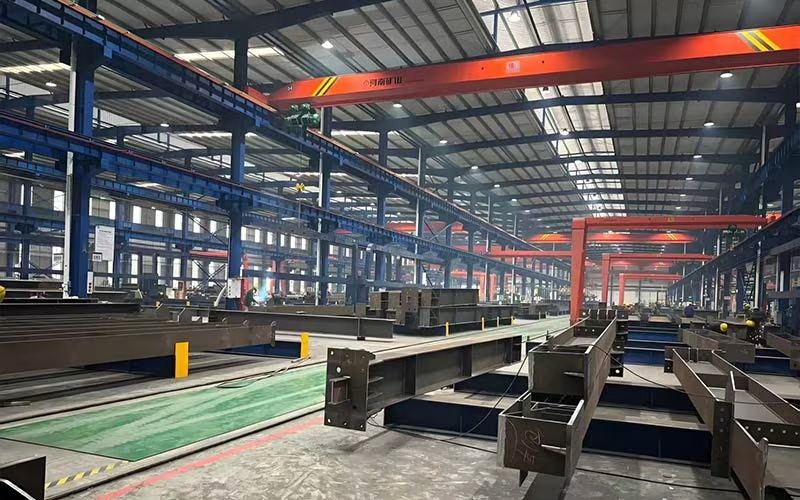
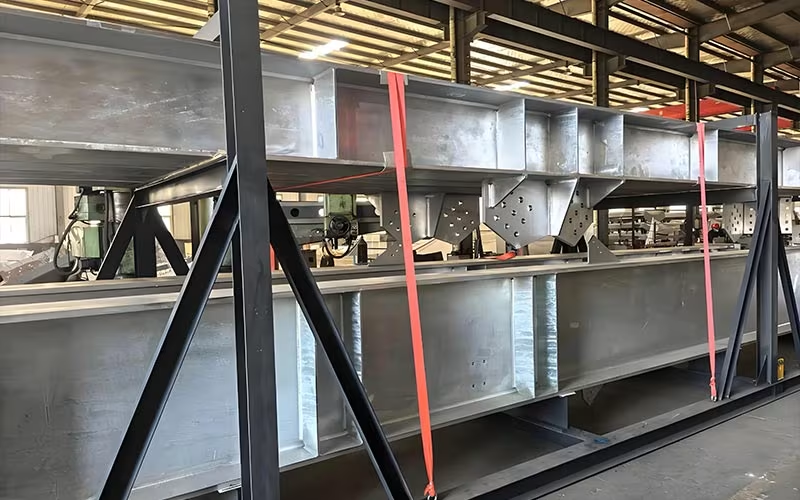
For industrial buyers comparing different building methods, Shandong No.7 Construction’s previous guide on prefabricated steel building planning is also useful because it explains how factory-made steel components can simplify site assembly and project coordination.
Clear Height Is a Long-Term Business Decision
Clear height is the usable vertical space inside the warehouse, measured from the finished floor to the lowest overhead obstruction. For an industrial steel warehouse, clear height affects storage density, racking flexibility, forklift selection, lighting placement, sprinkler design, ventilation, and future automation.
The important point is that clear height is difficult to change after construction. Raising a finished warehouse roof is usually far more complicated than planning the correct height from the beginning.
A low warehouse may be acceptable for simple floor storage, machinery parking, or light-duty use. But for high-density pallet storage, export logistics, industrial distribution, or future automated storage systems, extra vertical space can become extremely valuable.
When choosing clear height, consider:
Storage method, maximum stacking height, forklift lifting height, sprinkler clearance, lighting suspension, roof bracing, ventilation ducts, crane beams, mezzanine platforms, and possible future racking changes.
The best clear height is not always the highest possible height. It is the height that matches your operation while keeping structural design, wind load, wall panel selection, and energy performance in balance.
Column Grid: The Hidden Factor Behind Warehouse Efficiency
Column spacing is one of the most important design details in an industrial steel warehouse. Poor column placement can block forklift aisles, interrupt rack rows, reduce storage density, and create safety risks near vehicle routes.
A good column grid should be coordinated with:
Rack layout, forklift aisle width, loading dock location, cross-aisles, fire exits, production zones, equipment foundations, and future expansion plans.
For many industrial warehouses, the goal is not simply to remove every column. Long clear spans can improve flexibility, but they may also increase steel tonnage depending on loads and span requirements. In some projects, a carefully planned multi-span structure may be more practical than a full clear-span building.
The right solution depends on the warehouse function. A logistics center may need wider open zones near docks. A manufacturing warehouse may accept some internal columns if they align with equipment and aisles. A storage warehouse may prioritize rack-compatible column spacing. A maintenance warehouse may need wider bays for vehicles or large machinery.
Structural steel design resources from organizations such as the AISC Steel Solutions Center can help engineers and owners understand how steel framing choices affect project design.
Loading Dock Design Should Shape the Building Layout
For an industrial steel warehouse, the loading dock is not a small accessory. It is one of the busiest and highest-risk areas of the building.
A warehouse with an efficient storage area but a poorly planned dock can suffer from truck congestion, slow unloading, forklift conflicts, damaged doors, unsafe pedestrian movement, and poor weather protection.
Dock planning should consider:
Truck type, dock height, dock door quantity, door spacing, inbound and outbound separation, staging area, canopy coverage, truck court depth, traffic direction, forklift turning radius, pedestrian routes, drainage, and lighting.
Inside the building, enough staging space should be reserved near loading doors. If the staging zone is too small, goods may block aisles or create safety hazards. If the doors are placed without considering structural bays, bracing and columns may interfere with dock equipment.
OSHA’s warehousing guidance emphasizes practical safety measures around forklifts, loading docks, ramps, pedestrians, and vehicle operation, including keeping safe distances from dock edges and observing safe procedures during loading and stacking.
For buyers, this means warehouse design should combine structure and safety from the start. Door layout, dock edge protection, lighting, floor markings, and traffic separation should be discussed before fabrication drawings are finalized.
Roof and Wall Systems Affect Daily Warehouse Performance
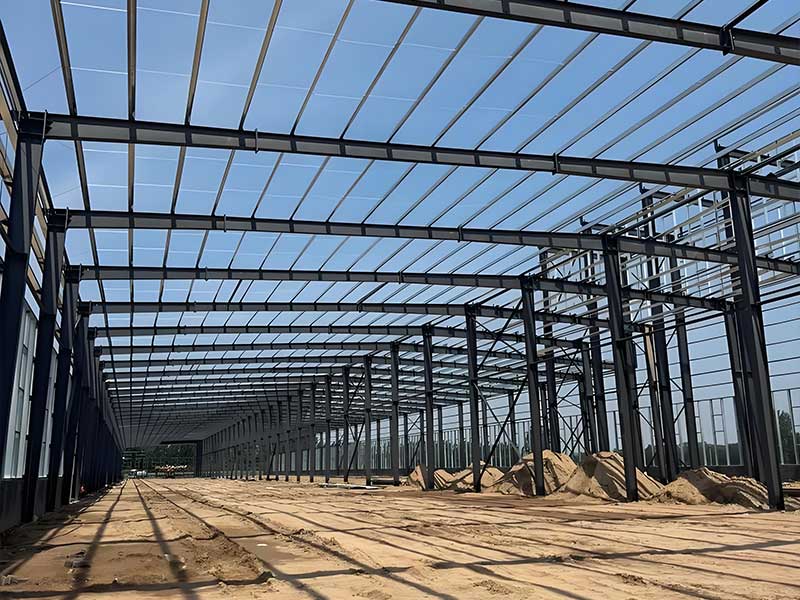
The primary steel frame carries the building, but the roof and wall systems determine how the warehouse feels and performs every day.
A warehouse in a hot climate may need insulation, ventilation, reflective roof materials, or skylight planning. A warehouse in a rainy area needs reliable roof slope, drainage, gutters, downpipes, and waterproof detailing. A warehouse near coastal or chemical environments may need stronger corrosion protection. A cold or temperature-sensitive warehouse requires careful control of thermal bridging, condensation, and door sealing.
Roof and wall planning should include:
Panel type, insulation thickness, vapor control, skylights, roof slope, ridge ventilation, gutter size, wall openings, louvers, access doors, fire separation, maintenance access, and coating system.
The Metal Building Manufacturers Association provides metal building design resources covering system-related considerations such as retrofitting, reinforcing, roofing, and building performance topics.
For Shandong No.7 Construction projects, buyers can also review the wider products page, which includes light steel, heavy steel, space trusses, pipe trusses, metal roof panels, truss floor decks, CZ-shaped steel, storage tanks, and steel silos.
Structural Loads Must Match the Real Project Location
An industrial steel warehouse must be designed for the site where it will be built. A structure that works in one region may not be suitable in another because wind, snow, seismic requirements, temperature differences, soil conditions, and local codes can vary significantly.
The design team should confirm:
Dead load, live load, wind load, snow load, seismic requirements, roof equipment load, suspended utility load, crane load, mezzanine load, rack load interaction, and serviceability limits.
The International Building Code Chapter 16 establishes minimum structural design requirements related to loads that buildings must resist. For steel-specific requirements, IBC Chapter 22 addresses steel construction, including structural steel and related steel systems.
For overseas projects, buyers should not rely on a generic warehouse design. The supplier should design according to the project location, applicable standards, engineering requirements, and owner specifications.
When to Use Light Steel, Heavy Steel, Truss, or Space Frame Systems
Not every industrial steel warehouse needs the same structure. The frame system should match span, height, load, building use, and budget logic.
A light steel structure is often suitable for standard warehouses, storage sheds, agricultural buildings, and light industrial facilities. It can support efficient fabrication and fast installation.
A heavy steel structure is better for warehouses with large loads, crane systems, multi-story areas, heavy equipment, or more demanding industrial conditions.
A steel truss structure can be useful when the warehouse requires a larger span or roof support with optimized material distribution. For facilities needing a more open interior, Shandong No.7 Construction provides steel truss structure solutions.
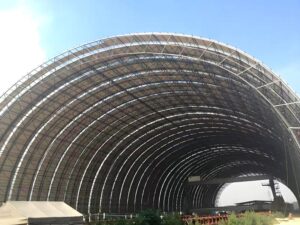
A space frame system is more common in large-span roofs, terminals, public buildings, stadiums, exhibition spaces, and special industrial covers. For large-span architectural or industrial projects, the company also provides space frame solutions.
For commercial industrial parks, showrooms, offices, and mixed-use buildings, commercial steel structure solutions may be more appropriate.
Fire Protection and Emergency Planning Cannot Be Added at the End
Warehouse fire protection is heavily influenced by what is stored, how high it is stored, how racks are arranged, how aisles are planned, and how sprinkler systems are designed. These are not only equipment decisions. They affect the building structure, roof space, clear height, wall separation, door layout, and utility coordination.
NFPA notes that modern warehouse and distribution facilities create specific fire protection challenges, especially when storage conditions, sprinkler design, and inspection requirements must be considered together.
During early design, the project team should coordinate:
Commodity type, storage height, rack arrangement, aisle width, sprinkler clearance, fire exits, smoke ventilation, fire separation, emergency vehicle access, hydrant location, and local fire authority requirements.
A warehouse that is designed only around storage density may create safety problems later. A better warehouse balances capacity, traffic, fire protection, and emergency access from the beginning.
Flooring and Foundation Planning Are Part of Warehouse Performance
Many buyers focus on the steel frame and forget that the floor is where warehouse work actually happens. Forklifts, racks, machines, pallets, and trucks all create loads that must be considered.
Floor planning should include:
Concrete slab thickness, flatness requirements, joint layout, rack base plates, wheel loads, equipment foundations, drainage slope, dust control, anti-slip finish, embedded parts, and future machine installation.
Foundation design should also be coordinated with steel columns and anchor bolts. Anchor bolt errors can delay installation and create alignment problems. Before fabrication, the project team should confirm the foundation plan, anchor bolt layout, column base details, site elevation, drainage, and installation access.
For industrial warehouses with cranes, mezzanines, or heavy equipment, the foundation and steel structure should be reviewed as one system.
Expansion Planning Can Save Future Disruption
Many warehouses are built for today’s business but quickly become too small. Future expansion is much easier when it is planned before construction.
An industrial steel warehouse can be designed with extension-friendly details, such as removable end walls, reserved frame lines, planned bracing positions, expandable roof and wall systems, and site space for later construction.
Expansion planning should consider:
Which direction the warehouse may grow, how the roof will connect, whether future columns will align with the existing frame, how drainage will change, how fire exits will be adjusted, and whether truck traffic will be interrupted during expansion.
A warehouse built without expansion planning may require demolition, structural modification, or operational shutdown later. A warehouse built with future growth in mind can support business changes with less disruption.
Sustainability Is About Durability, Reuse, and Efficient Design
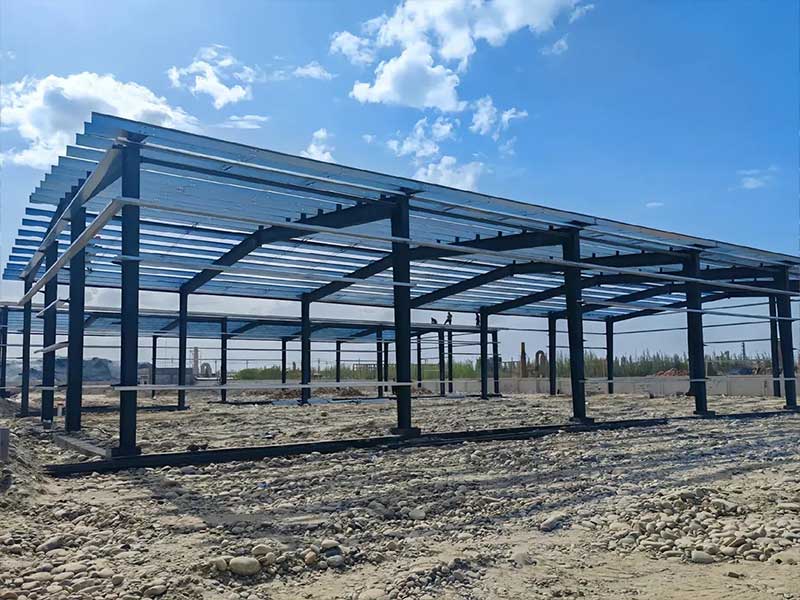
Sustainability in an industrial steel warehouse should not be limited to marketing language. It should be built into material selection, structural optimization, fabrication accuracy, transport planning, corrosion protection, maintenance access, and future adaptability.
Steel is widely recognized for its recycling potential. The World Steel Association explains that available steel scrap can be recycled repeatedly into new steel products in a closed material loop.
For warehouse owners, sustainability can be improved through:
Accurate design to reduce waste, durable coating systems, efficient roof and wall insulation, natural lighting where appropriate, ventilation planning, reusable structural components, future expansion planning, and maintenance-friendly details.
A warehouse that lasts longer, adapts more easily, and requires fewer major repairs usually delivers better long-term value.
How to Choose an Industrial Steel Warehouse Contractor
A strong industrial steel warehouse project depends on more than steel production. The contractor should understand engineering, fabrication, logistics, installation, project management, and after-sales support.
A good supplier should help clarify:
Building use, local design loads, structural system, span, height, column grid, roof and wall system, surface treatment, packing method, shipping plan, installation guidance, and future maintenance.
Shandong No.7 Construction describes its service model as a full-industry-chain solution covering R&D and design, production and manufacturing, engineering construction, project management, overseas project services, and after-sales support. Buyers can review the company’s services page for more details.
The website also shows project experience across steel structures, industrial buildings, storage tanks, gas stations, and large-span structures, including domestic and overseas project cases. For reference, buyers can review the company’s Qijian Cases page.
Information to Prepare Before Requesting a Solution
Before requesting a custom industrial steel warehouse proposal, prepare enough information for the supplier to understand the real project.
Useful information includes:
Project location, warehouse function, building length and width, required clear height, local wind and snow conditions, seismic requirements, storage method, rack height, forklift type, dock quantity, door size, insulation needs, ventilation requirements, fire protection requirements, crane or mezzanine needs, surface treatment expectations, project schedule, and future expansion plan.
Drawings, site photos, layout sketches, and equipment lists can also help the engineering team provide a more practical solution.
For project communication, buyers can submit requirements through the Contact Us page.
Common Mistakes to Avoid
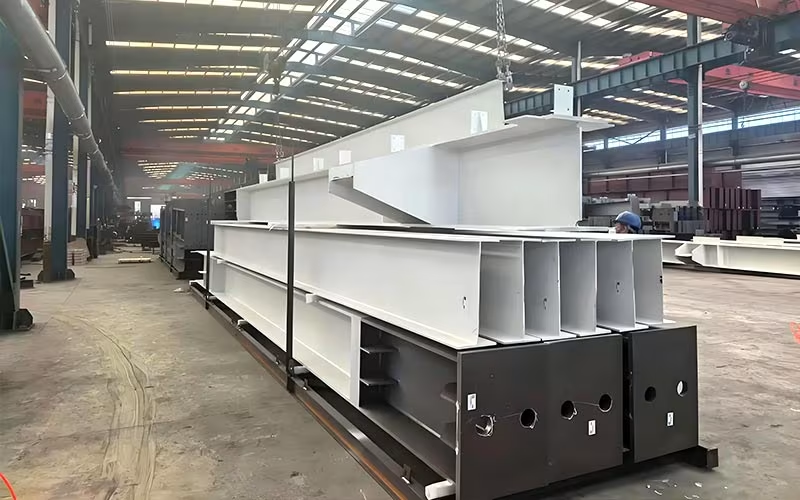
One common mistake is choosing the lowest initial specification without checking whether it supports long-term warehouse operations.
Another mistake is finalizing the steel frame before confirming racking, forklift routes, loading docks, fire exits, and future expansion. These elements directly affect the structure.
A third mistake is ignoring roof and wall performance. Water leakage, condensation, poor ventilation, and heat gain can create daily problems even when the frame is strong.
A fourth mistake is treating safety as an afterthought. Forklift routes, dock edges, pedestrian separation, lighting, emergency exits, and fire protection should be included early.
A fifth mistake is not checking supplier capability. Design, fabrication, packing, delivery, and installation support must work together. A warehouse is not only a product; it is a complete project system.
Conclusion
An industrial steel warehouse should be designed around workflow, not just square meters. Clear height, column spacing, loading docks, roof systems, wall panels, structural loads, fire protection, floor performance, and expansion planning all affect how well the warehouse supports business operations.
Steel structure warehouses are popular because they can provide flexible space, strong load-bearing capacity, efficient fabrication, fast installation, and long-term adaptability. But the best results come from early planning and professional coordination.
Shandong No.7 Construction supports industrial buyers with integrated steel structure products, manufacturing capability, engineering services, and project experience. For warehouses, logistics centers, workshops, industrial plants, and commercial steel buildings, a well-planned steel structure can become a reliable foundation for long-term growth.
FAQ
What is an industrial steel warehouse?
An industrial steel warehouse is a warehouse building that uses steel columns, beams, bracing, purlins, roof panels, wall panels, and related components as the main structural and enclosure system.
Why choose steel structure for an industrial warehouse?
Steel structure is widely used for industrial warehouses because it supports large spans, flexible layouts, factory fabrication, efficient installation, and future expansion planning.
What is the most important design factor for a steel warehouse?
The most important factor is the warehouse operation. Storage method, forklift movement, loading docks, clear height, column spacing, and fire protection should guide the structural design.
Can an industrial steel warehouse be customized?
Yes. It can be customized by size, span, height, roof system, wall panel, insulation, doors, windows, ventilation, crane beams, mezzanine areas, loading docks, and surface treatment.
Is clear height important for warehouse design?
Yes. Clear height affects storage density, racking layout, forklift selection, sprinkler clearance, lighting, ventilation, and future automation options.
Can a steel warehouse be expanded later?
Yes, many steel warehouses can be designed for future expansion. Expansion direction, bracing layout, roof connection, wall removal, and site space should be planned during the initial design stage.
What should buyers prepare before requesting a warehouse quotation?
Buyers should prepare project location, building size, warehouse use, clear height, load requirements, dock layout, door sizes, insulation needs, local climate conditions, fire protection requirements, and future expansion plans.
Continue reading


Shandong No.7 Construction Engineering Co., Ltd. is a large-scale modern construction enterprise integrating R&D, design, production, construction and general contracting of steel structures, with business covering both domestic and international markets.