Quels sont les principaux types de structures en acier utilisés dans la construction moderne ?
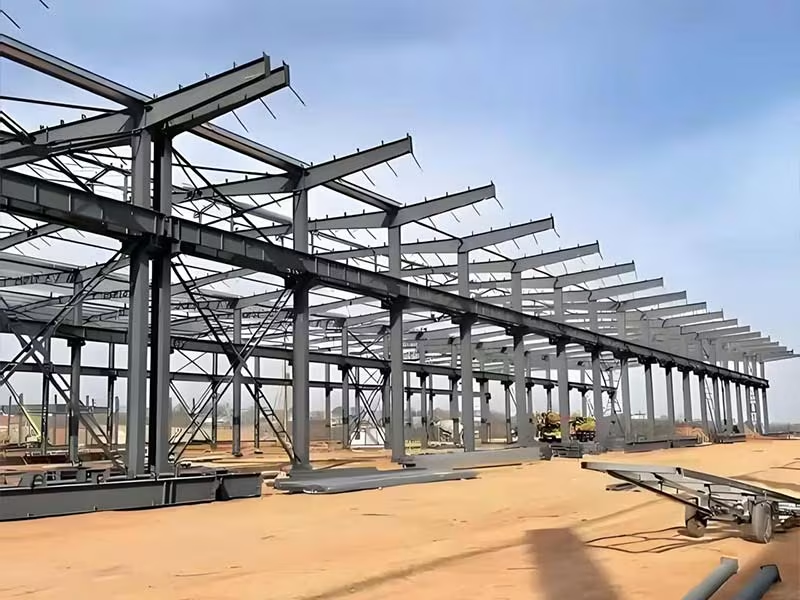
Steel construction has become the backbone of modern industrial and commercial development. Whether it is a logistics warehouse, a manufacturing plant, or a large-span public facility, steel systems are chosen for one simple reason: they solve structural problems that traditional building methods struggle with—speed, span, and strength.
From a manufacturing perspective, steel structures are not just “building frames.” They are engineered systems that combine design logic, fabrication precision, and on-site assembly efficiency. Understanding how these systems differ is essential for making the right engineering decisions early in a project.
Les structures en acier ne sont pas un système, elles sont un ensemble de solutions d'ingénierie
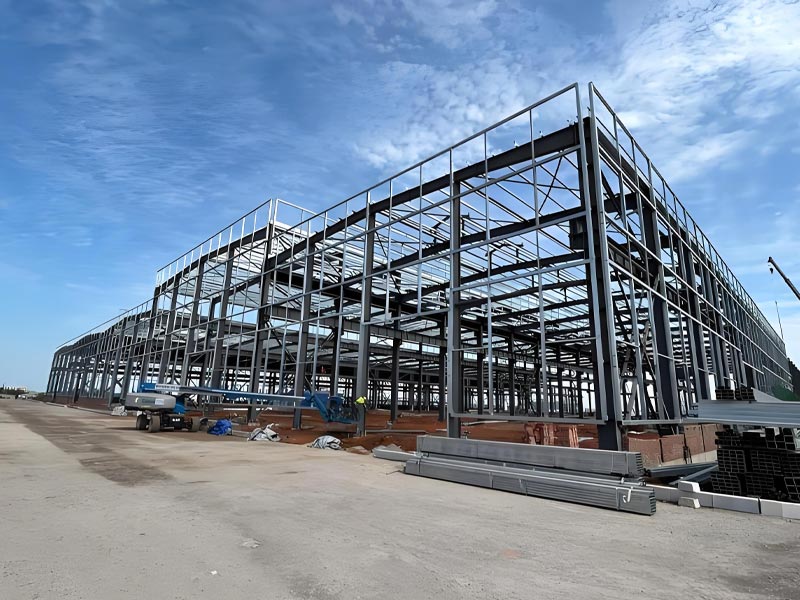
One common misunderstanding in construction planning is treating steel structures as a single category. In reality, they are a group of structural systems, each designed for a specific load behavior and construction scenario.
In practice, most projects fall into a few repeatable structural logic patterns:
- Long-span open space requirements
- Multi-storey vertical load systems
- Rapidly assembled industrial buildings
- Complex roof geometry structures
Each requirement leads to a different structural type. That is why structure d'acier classification is less about theory and more about real-world engineering adaptation.
Les types de structure en acier de base utilisés dans les projets d'ingénierie
Instead of listing definitions in isolation, it is more useful to look at how each system behaves in actual construction environments.
Systèmes de cadres de portails : le choix par défaut pour l'espace industriel
Portal frame structures are widely used in industrial construction because they balance simplicity and performance.
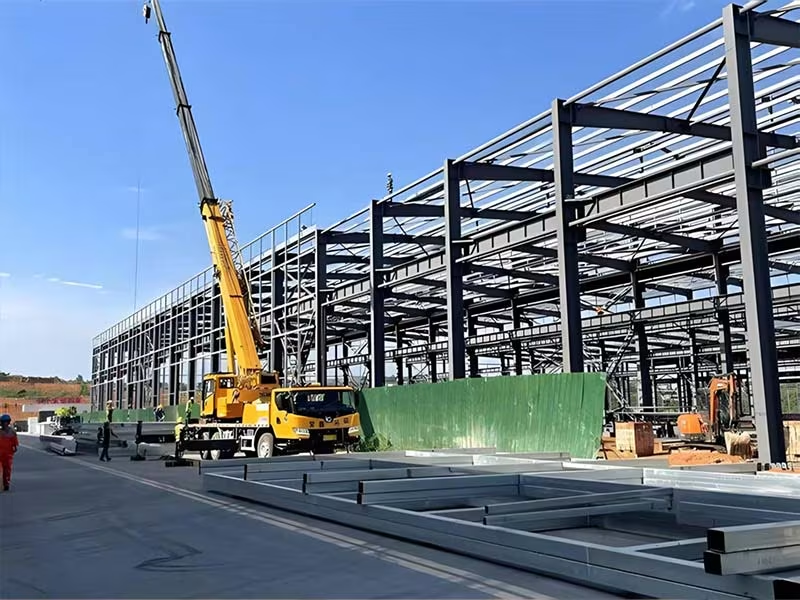
They are built on a rigid connection between columns and beams, forming a stable frame that can cover wide interior spaces without internal columns.
Where they perform best:
- entrepôts
- Workshops
- Agricultural storage buildings
- Standard industrial facilities
What makes them practical is not just structural stability, but manufacturing consistency. In factory production, portal frames are efficient to fabricate, easy to standardize, and well-suited for modular delivery.
Systèmes de cadres de l'espace - lorsque la durée devient le principal défi
Some projects are not limited by height or function, but by horizontal distance. This is where space frame structures come into play.
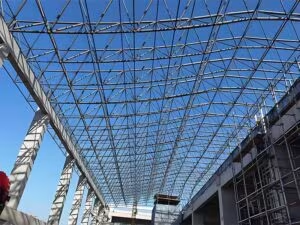
Instead of relying on single-direction beams, space frames use a three-dimensional grid system to distribute forces evenly across the structure.
They are commonly found in:
- aéroports
- Toits de stade
- Exhibition halls
- Large public infrastructure coverings
From an engineering production standpoint, space frames require precise coordination between design and fabrication. Even small deviations in joint geometry can affect the overall load balance, which is why manufacturing control becomes critical.
Systèmes de truss — Efficacité grâce à la géométrie
Truss structures are based on one simple engineering principle: triangles distribute force efficiently.
This system replaces solid beams with interconnected members, reducing material usage while maintaining structural strength.
Typical use cases include:
- Bridge structures
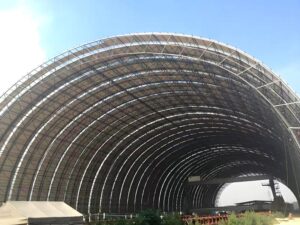
- Long-span roof systems
- Heavy-load industrial frames
What makes truss systems particularly interesting from a manufacturing perspective is their sensitivity to precision. Every node connection contributes to overall stability, meaning fabrication accuracy directly impacts structural performance.
Systèmes de cadre rigides — Stabilité sous charges dynamiques
Rigid frame structures are designed to resist bending moments through fixed beam-column connections.
They are commonly applied in:
- Multi-storey buildings
- Commercial complexes
- Structures exposed to wind or seismic forces
Unlike simpler systems, rigid frames rely heavily on connection performance. Welding quality, alignment control, and joint stiffness all influence the final behavior of the building.
This is one reason why they are often selected for projects requiring higher structural reliability rather than just open space.
Prefabrication Has Changed How Steel Structures Are Built
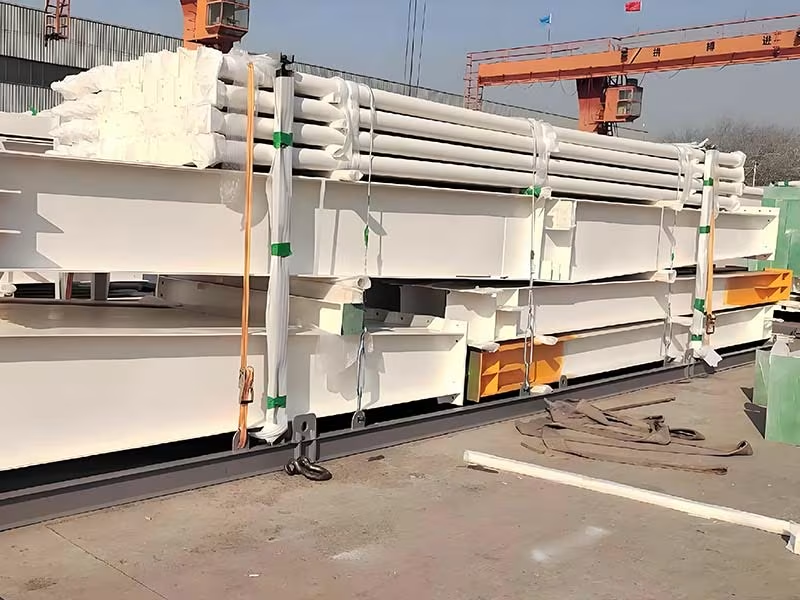
One of the biggest shifts in the industry is not structural design—it is where and how structures are made.
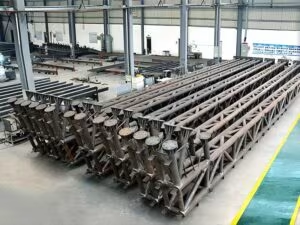
Today, most steel components are manufactured in controlled environments before reaching the construction site. This approach reduces uncertainty and improves consistency.
A typical production process includes:
- Material preparation and cutting
- Automated welding and assembly
- Surface treatment for corrosion protection
- Pre-assembly checks before shipment
This method does not just improve speed. It changes the entire logic of construction. Instead of building everything on-site, projects are now assembled like engineered systems.
Pourquoi le choix de la structure en acier n'est jamais unique
Choosing a structural type is not a design preference—it is a technical decision influenced by multiple constraints.
Key factors usually include:
- Span requirements
- Building function
- Load conditions
- Exposition environnementale
- Installation conditions
- Maintenance expectations
In many cases, a project may even combine multiple structural systems rather than relying on a single one.
For example, a facility might use:
- Portal frames for the main workshop
- Truss systems for roofing
- Rigid frames for office sections
This hybrid approach is increasingly common in modern industrial design.
Where Manufacturing Expertise Becomes a Deciding Factor
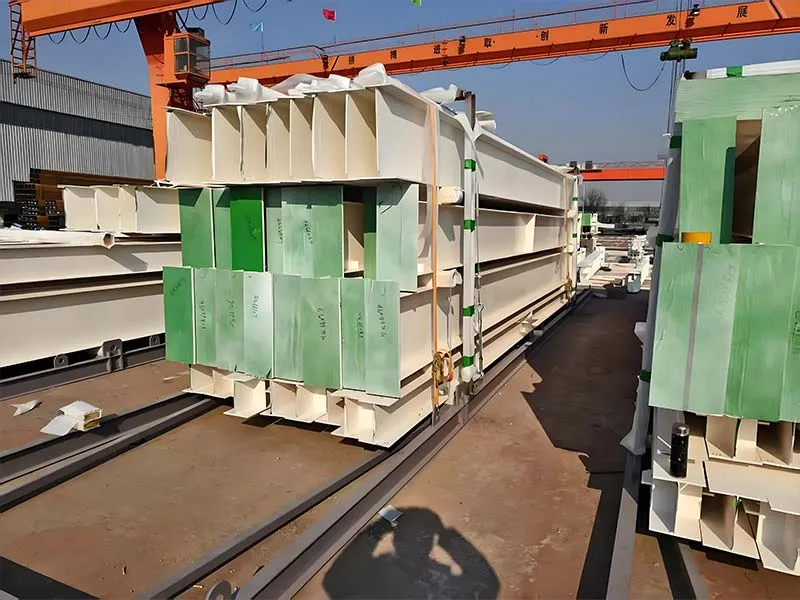
A structural design on paper is only part of the equation. What determines real-world performance is how accurately it is manufactured.
This is where structure d'acier manufacturers play a critical role.
Their responsibility goes beyond fabrication:
- Translating engineering drawings into production reality
- Ensuring consistency across large-scale components
- Managing tolerances during welding and assembly
- Preparing structures for efficient on-site installation
In practice, the quality of fabrication often has more impact on project success than the complexity of the design itself.
How Steel Structure Types Are Used Across Industries Today
Steel systems are now used across nearly every major construction sector:
- Industrial production facilities
- Logistics and distribution centers
- Agricultural storage systems
- Commercial complexes
- Transportation infrastructure
What differs between these applications is not the material, but the structural logic behind them. Each sector prioritizes different performance factors such as span, durability, or construction speed.
Where the Industry Is Moving Next
Steel construction is gradually shifting toward more integrated and efficient systems.
Several trends are becoming more visible:
- Greater use of digital structural modeling
- Increased reliance on prefabricated modular systems
- More standardized component production
- Reduced on-site welding and manual adjustment
- Higher demand for customized engineering solutions
The direction is clear: less manual construction, more engineered manufacturing.
Conclusion
Steel structure types are not just engineering categories—they are practical solutions developed for different construction challenges. Portal frames handle industrial space efficiently, space frames solve long-span problems, trusses optimize material performance, and rigid frames provide stability under complex loads.
From a manufacturing standpoint, the real value lies in how these systems are produced, controlled, and assembled. As construction continues to move toward prefabrication and modular engineering, the line between design and manufacturing becomes increasingly important.
Understanding these systems is not only useful for engineers and contractors, but essential for anyone involved in planning modern construction projects.
FAQ
Q1: What are the main steel structure types used in construction?
A: The most common types include portal frame structures, space frame systems, truss structures, and rigid frame systems. Each is designed for different spans, loads, and building functions.
Q2: Which structure d'acier type is best for warehouses?
A: Portal frame structures are most widely used for warehouses due to their large clear-span capability, simple design, and efficient fabrication process.
Q3: What is the difference between truss and rigid frame structures?
A: Truss structures rely on triangular units for efficient load distribution, while rigid frames use fixed beam-column connections to resist bending and improve overall stability.
Q4: Are steel structure types prefabricated in factories?
A: Yes, most steel structures are manufactured in factories through cutting, welding, and assembly processes before being transported to the construction site for installation.
Q5: How do I choose the right steel structure type for a project?
A: The selection depends on factors such as span requirements, building purpose, load conditions, budget planning, and environmental factors. Engineering evaluation is usually required for accurate selection.
Continuer la lecture
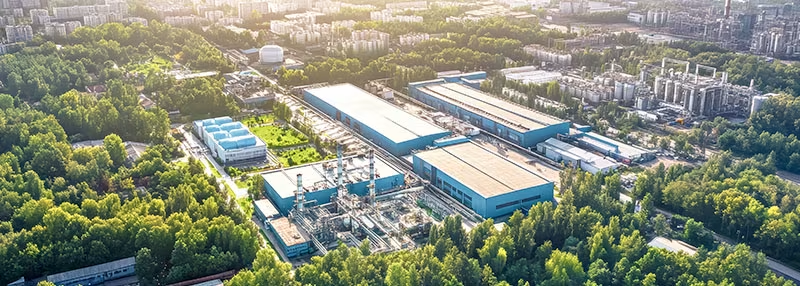
1TP2 T est une entreprise de construction moderne à grande échelle intégrant la R & D, la conception, la production, la construction et la passation de contrats généraux de structures en acier, avec des activités couvrant à la fois les marchés nationaux et internationaux.