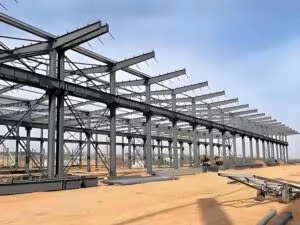
أنواع الجمالونات الفولاذية: دليل الشركة المصنع الكامل للبناء الحديث
مقدمة
Steel trusses have become the backbone of contemporary construction, offering unmatched structural efficiency for projects ranging from small warehouses to massive exhibition centers. As a steel truss manufacturer with decades of production experience, we understand that selecting the right structural system can make or break a project—both literally and financially.
Unlike traditional solid-beam construction, steel truss systems achieve superior load-bearing capacity while using significantly less material. This efficiency translates directly to cost savings and design flexibility that architects and engineers increasingly demand.
For anyone involved in specifying, purchasing, or constructing steel-framed buildings, understanding the various steel trusses types available is essential. Whether you're an engineer evaluating structural options, a project manager comparing costs, or a buyer seeking the best value from a manufacturer, this comprehensive guide covers everything you need to know about modern steel truss technology.
ما هي أنواع الجمالونات الفولاذية وكيف تعمل؟
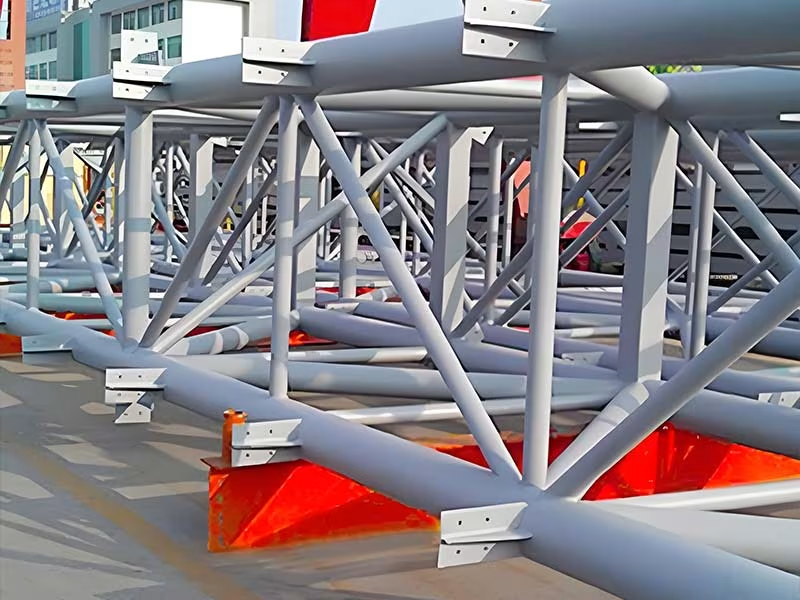
A steel truss is a structural framework composed of straight members connected at joints (nodes) to form triangular configurations. This geometry is deceptively simple yet incredibly efficient, distributing loads through a combination of tension and compression forces along each member.
How load distribution works:
When external forces act on a truss—whether from roof weight, wind pressure, or equipment loads—the system channels these forces down through the members to the support points. The triangular arrangement ensures that each member primarily experiences either tension (pulling) or compression (pushing), rather than bending. This axial loading allows truss members to be much slimmer than solid beams carrying equivalent loads.
Compared to traditional I-beam or solid steel beam systems, trusses offer several distinct advantages:
- Greater span capability with less material
- Reduced dead weight of the structural system
- Open web design allowing mechanical, electrical, and plumbing runs
- Design flexibility for complex architectural requirements
The engineering principles behind steel trusses types focus on optimizing member sizes, connection details, and overall geometry to match specific load requirements. Modern finite element analysis and computer-aided design have refined these principles into highly sophisticated tools for structural engineers.
الفئات الرئيسية لأنواع الجمالونات الفولاذية المستخدمة في البناء
Understanding the primary الجمالونات types helps professionals select the optimal configuration for their specific application. Each design offers distinct performance characteristics suited to different span ranges and load conditions.
Parallel Chord Trusses
Parallel chord trusses feature top and bottom chords running horizontally and parallel to each other. The vertical and diagonal members connect these chords, creating a rectangular web pattern. This configuration works exceptionally well for floor systems where uniform depth is beneficial, and it simplifies connection details for floor decking or ceiling installations.
الجمالونات
The Pratt truss design positions diagonal members angled toward the center of the span, with vertical members carrying tension loads while diagonals handle compression. This arrangement proves highly efficient for gravity-loaded applications because the diagonals work with, rather than against, the natural direction of forces.
Pratt trusses excel in medium to large span applications, typically ranging from 15 to 40 meters. You'll commonly find this configuration in industrial buildings, bridges, and anywhere where overhead clearance matters. The design's predictable load path simplifies engineering calculations and construction sequencing.
الجمالونات وارين
Warren trusses construct their web system from equilateral triangles, with alternating diagonal members running in opposite directions. This arrangement creates a natural load path where forces distribute evenly across all diagonal members, making the system highly efficient for distributed loads.
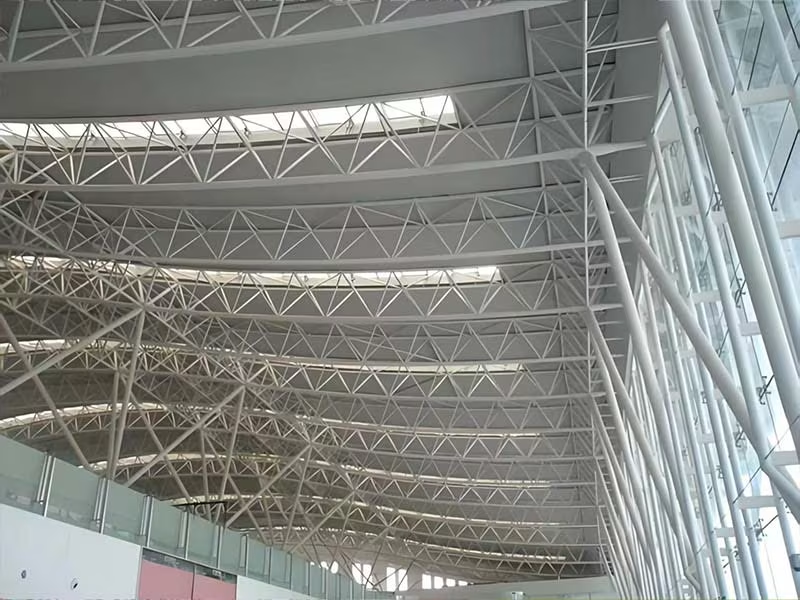
The Warren configuration handles large spans effectively, from approximately 20 to 100 meters. Its clean geometric appearance has made it popular for architectural applications where exposed structure adds aesthetic value—think airport terminals, exhibition halls, and covered walkways.
Fink Trusses
Fink trusses feature a distinctive W-pattern web configuration, with multiple diagonal members branching from a central point. This design maximizes efficiency in shorter spans while minimizing material usage, making it one of the most economical steel trusses types available.
Typical applications for Fink trusses include residential construction, small commercial buildings, and agricultural structures with spans between 5 and 15 meters. The configuration's nested triangle design provides excellent strength-to-weight ratio for lighter loading conditions.
Bowstring Trusses
Bowstring trusses curve along the top chord while maintaining a flat bottom chord, resembling an archer's bow. This shape naturally resists bending moments, making it particularly effective for roof applications where the curved profile also facilitates water drainage.
Historically popular for aircraft hangars and industrial buildings, bowstring trusses remain relevant today for applications requiring both structural efficiency and architectural distinction. The curved geometry does increase fabrication complexity compared to straight-chord designs.
أنواع دعامات الأسقف الفولاذية للمباني الصناعية والتجارية
Roof structures present unique challenges that influence steel trusses types selection. Beyond supporting dead loads from roofing materials and potential snow accumulation, roof trusses must resist wind uplift, seismic forces, and sometimes equipment loads from HVAC systems or solar panels.
Roof Load Requirements and Structural Stability
Industrial and commercial roofs typically require trusses capable of handling:
- Dead loads: Roofing materials, insulation, ceiling systems, and permanent equipment
- Live loads: Maintenance personnel, snow accumulation, or concentrated equipment weights
- Environmental loads: Wind pressure (including uplift), seismic forces, and thermal expansion
- Dynamic loads: Cranes, machinery vibration, or crowd movement in assembly venues
Modern steel roof trusses types must also accommodate thermal movement without inducing stress concentrations, provide attachment points for secondary systems, and maintain structural integrity throughout the building's service life—typically 50+ years for commercial structures.
Long-Span Steel Roof Truss Systems
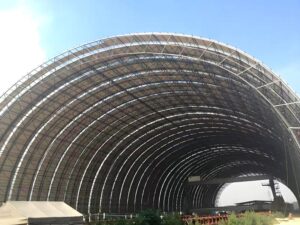
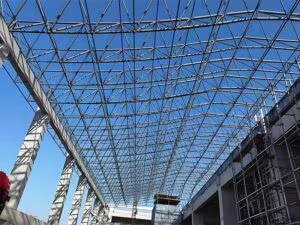
Warehouses, factories, and large commercial spaces frequently require clear spans exceeding 30 meters to maximize usable floor area. Long-span steel roof trusses address this need through optimized section sizes, efficient web configurations, and sometimes Vierendeel or space frame alternatives for extremely demanding applications.
Our manufacturing facility regularly produces long-span roof trusses up to 60 meters for single-piece transport, with field splicing options extending that capability significantly. The key lies in balancing structural efficiency against fabrication cost and transport limitations.
Warehouse and Factory Roofing Solutions
Industrial buildings often prioritize:
- Maximum clear height for racking systems or overhead cranes
- Rapid construction to meet occupancy deadlines
- Low maintenance over decades of industrial use
- Future flexibility for layout modifications
Steel roof trusses types for these applications typically emphasize practical considerations: standardized connections, coordinated hole patterns for secondary framing, and finish systems resistant to industrial atmospheres.
أنواع الدعامات الفولاذية للهياكل طويلة المدى
Long-span construction challenges conventional assumptions about structural design. As spans increase beyond 40 meters, the ratio of structural weight to carried load becomes critical, driving demand for increasingly sophisticated steel truss solutions.
Design Requirements for Large-Span Buildings
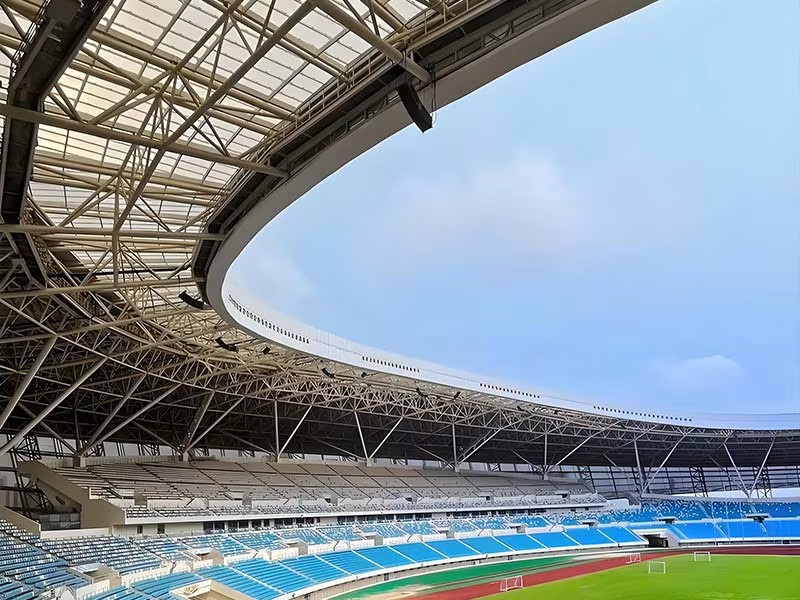
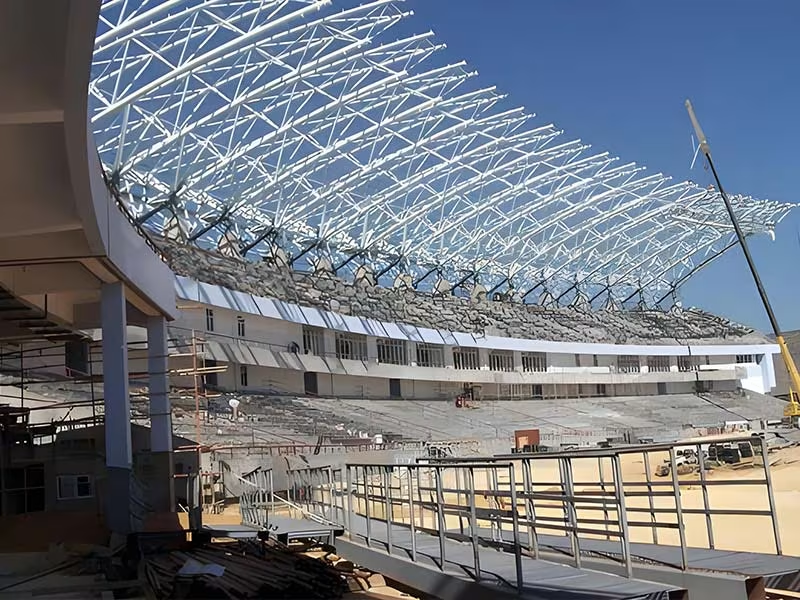
Stadiums, airport terminals, exhibition centers, and industrial process facilities commonly require clear spans from 50 to 200 meters. At these scales, structural efficiency directly impacts construction cost, foundation requirements, and overall building proportions.
Long-span الجمالونات must address:
- P-delta effects: Secondary stresses from member compression under large loads
- Lateral stability: Buckling prevention through effective bracing systems
- Deflection control: Maintaining serviceability under full and partial loads
- Connection design: Transferring substantial forces without excessive fabrication expense
Stadiums, Airports, and Exhibition Halls
These iconic structures showcase what's possible with modern steel trusses types. The Beijing National Stadium (Bird's Nest) employed elaborate branching steel members, while countless exhibition halls use Warren or K-truss configurations to achieve column-free interiors spanning over 100 meters.
Architectural expression often drives truss selection for such projects, with exposed structure becoming a design feature rather than concealed necessity. Our engineering team has collaborated on several landmark projects where truss geometry became a defining architectural element.
Lightweight vs Heavy-Duty Truss Selection
Not all long-span applications require massive structural members. Tensile membrane systems combined with light-gauge steel trusses can achieve impressive spans while minimizing material consumption. Conversely, heavy industrial facilities with crane loads demand robust truss systems capable of withstanding dynamic forces over millions of loading cycles.
The appropriate choice depends on:
- Anticipated load magnitude and variation
- Required deflection limits
- Building function and service life
- Aesthetic requirements
- Construction budget constraints
عملية تصنيع أنواع الجمالونات الفولاذية (رؤية المصنع)
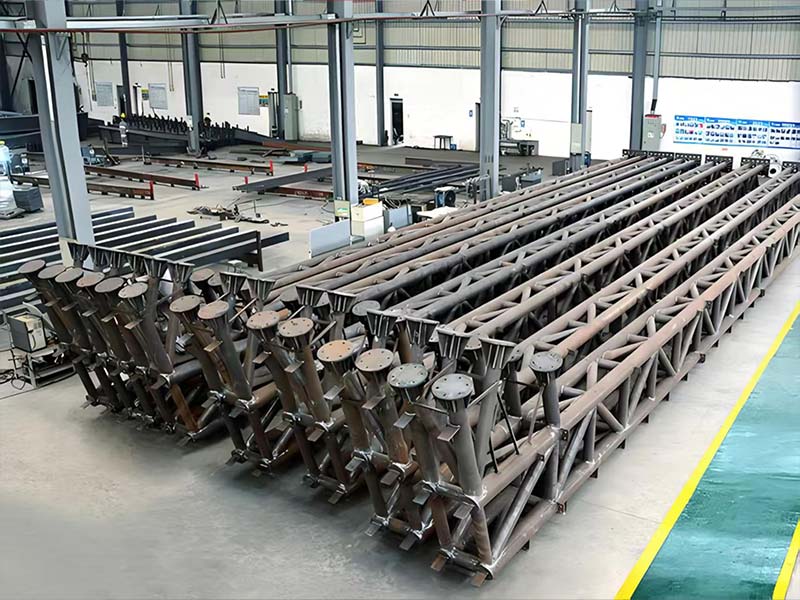
Understanding how الجمالونات types are actually manufactured provides valuable context for procurement decisions. Modern fabrication combines sophisticated equipment with skilled craftsmanship to produce structural components meeting exacting standards.
Material Selection: Carbon Steel vs Galvanized Steel
Steel trusses begin with material selection. Carbon structural steel remains the most common choice, with grades including:
- Q235: General-purpose carbon steel, cost-effective for lighter applications
- Q345/Q355: Higher strength steel reducing member sizes for equivalent loads
- Q420: Ultra-high strength for specialized applications
Galvanized steel offers enhanced corrosion resistance for exposed applications or aggressive environments. The zinc coating protects underlying steel through both barrier and sacrificial mechanisms, extending service life significantly in humid, coastal, or industrial atmospheres.
Our mill partnerships ensure consistent material properties and full traceability from heat number through finished product.
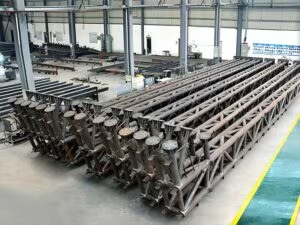
Cutting, Welding, and Assembly Process
Modern steel truss fabrication follows a streamlined sequence:
- Material preparation: Steel arrives as hot-rolled sections or plates, inspected and sorted
- Cutting: CNC cutting equipment handles straight and beveled cuts with precision
- Hole formation: Drilling or punching creates connection holes to specification
- لحام: Qualified welders perform groove welds for moment connections, fillet welds for stiffeners and plates
- Assembly: Fitting and tack welding assembles components into complete trusses
- Inspection: NDT (non-destructive testing) verifies weld quality
- Surface preparation: Blast cleaning or grinding prepares surfaces for coating
- Finishing: Primer and topcoat application protects against corrosion
Each stage includes documentation and sign-off, creating complete audit trails for quality assurance.
Prefabrication and Modular Production Advantages
Factory-controlled production offers significant advantages over field fabrication:
- Consistent quality: Controlled environment, calibrated equipment, trained personnel
- Reduced waste: Optimized nesting and efficient material utilization
- Faster delivery: Parallel processing of multiple components
- Weather independence: Production continues regardless of site conditions
- Testing capability: Full-scale load testing verifies structural performance
Prefabricated steel trusses arrive at the job site ready for installation, minimizing field labor and associated scheduling complications.
مقارنة أنواع الجمالونات الفولاذية: القوة والتكلفة والأداء
Selecting the appropriate steel trusses types requires balancing multiple factors. The following comparison illustrates typical characteristics across common configurations.
| Truss Type | نطاق امتداد نموذجي | Material Efficiency | Fabrication Complexity | Cost Index | Best Applications |
|---|---|---|---|---|---|
| Pratt Truss | 15-40m | سام رف | اعتدالي | 1.0 | Industrial buildings, bridges |
| Warren Truss | 20-100m | منتشي جدا | اعتدالي | 1.1 | Long-span roofs, exposed structures |
| Fink Truss | 5-15m | اعتدالي | نزل | 0.8 | Residential, agricultural, light commercial |
| Parallel Chord | 10-60m | Moderate-High | نزل | 0.9 | Floor systems, roof purlins |
| Bowstring Truss | 20-80m | اعتدالي | سام رف | 1.3 | Architectural roofs, hangars |
Cost Index represents relative material and fabrication cost; 1.0 represents baseline
Load-Bearing Capacity Comparison
Structural efficiency varies with configuration and span. For equivalent spans and loading conditions:
- Warren trusses typically use 10-15% less steel than Pratt configurations
- Fink trusses achieve excellent efficiency in short spans where web member lengths remain manageable
- Parallel chord trusses perform best when uniform depth simplifies connection details
Heavy loading conditions favor configurations with shorter compression members, as buckling resistance scales with member length. For heavy industrial roofs or crane-supporting structures, Pratt and modified Pratt configurations often outperform alternatives.
Installation Complexity and Construction Speed
Simpler truss geometries install faster:
- Standardized connections reduce field fitting time
- Pre-assembled components minimize crane time per piece
- Repeatable geometry simplifies alignment and connection
Complex trusses with curved chords, variable depth sections, or intricate connections require more careful handling and precise setting. Planning should account for these factors when scheduling and budgeting.
Maintenance and Durability Factors
كل ما يملك الجمالونات require some maintenance over their service life:
- Coating systems typically last 15-25 years before recoating becomes necessary
- Connection details should prevent water accumulation and enable inspection
- التعرض البيئي drives maintenance frequency in aggressive atmospheres
Galvanized finishes reduce maintenance requirements significantly but increase initial cost by approximately 20-40%. For buildings with limited access or harsh environments, this trade-off often proves economical.
كيفية اختيار أنواع الجمالونات الفولاذية المناسبة لمشروعك
Selecting optimal steel trusses types involves systematically evaluating project requirements against available options. Here's our approach as a manufacturer helping customers make informed decisions.
Building Type Considerations
Industrial facilities (warehouses, factories, distribution centers) typically prioritize:
- Clear span capability for flexible interior layouts
- Durability under heavy use and industrial atmospheres
- Cost-effective solutions for large roof areas
- Accommodations for overhead cranes or equipment loads
المباني التجارية (offices, retail, hospitality) may emphasize:
- Aesthetic possibilities with exposed structure
- Coordination with HVAC and electrical systems
- Speedy construction to meet market timing
- Long-term flexibility for layout changes
Agricultural structures (barns, storage, processing facilities) generally require:
- Economical solutions for lower load requirements
- Corrosion resistance in ammonia-rich environments
- Wide clearspan configurations
- Simple, reliable performance
Span Length and Load Requirements
Begin truss selection by establishing clear parameters:
- Minimum clear span required between supports
- Maximum allowable deflection for roof or floor decking
- Design loads including dead, live, snow, wind, and seismic
- Concentrated loads from equipment, cranes, or solar arrays
With these parameters established, span-to-depth ratios guide initial truss selection. Most steel trusses types perform optimally at depth-to-span ratios between 1:10 and 1:20, with deeper trusses reducing material requirements but increasing overall building height.
Environmental and Seismic Factors
Building codes in different regions mandate specific design criteria:
- Seismic zones require ductile connection details and appropriate redundancy
- Corrosive environments may necessitate galvanized or weathering steel options
- Coastal locations demand enhanced corrosion protection
- Extreme cold requires consideration of steel toughness properties
Our engineering team evaluates site-specific conditions during quotation to recommend appropriate configurations and material specifications.
Custom Design vs Standard Truss Solutions
Standard trusses offer:
- Shorter lead times (typically 2-4 weeks)
- Lower unit costs through repetition
- Proven, documented performance
- Simplified specification and permitting
Custom trusses provide:
- Optimized solutions for unusual requirements
- Architectural integration with distinctive designs
- Efficient material usage for unusual spans or loads
- Complete design responsibility from manufacturer
For projects with standard geometries and loading, we typically recommend standard configurations. Complex projects or unusual requirements benefit from custom engineering that optimizes the structural solution.
تطبيقات أنواع الجمالونات الصلب في مختلف الصناعات
Steel trusses types serve diverse market sectors, each with distinct requirements driving configuration selection.
Industrial Warehouses and Logistics Centers
Modern distribution facilities demand large, clear floor areas for racking systems, truck docks, and operations. Long-span steel roof trusses provide column-free interiors maximizing storage density and operational flexibility.
Key considerations include:
- Roof slopes sufficient for drainage (typically 1/2:12 to 1:4:12)
- Attachment points for sprinkler systems, lighting, and conveyers
- Coordinated design with standing seam or built-up roofing systems
- Provisions for future solar panel installation
Agricultural Buildings and Storage Facilities
Farm and agricultural structures present unique challenges:
- Corrosive atmospheres from livestock, fertilizers, and grain dust
- Wide clearspan requirements for equipment and storage
- Cost sensitivity given agricultural economics
- Potential for future expansion
Fink and modified Fink trusses often provide optimal solutions, combining economy with adequate performance for these applications. Galvanized finishes prove particularly valuable in agricultural environments.
Commercial and Retail Construction
Modern commercial architecture frequently exposes structural steel as a design feature:
- Open-plan retail spaces benefit from long-span capability
- Exposed trusses contribute to contemporary aesthetic
- Integration with mechanical systems running through structural bays
- Coordination with curtain wall and glazing systems
Warren and Pratt configurations offer clean lines suitable for exposed applications, with connection details designed for architectural presentation.
Infrastructure Projects
Beyond buildings, steel trusses types appear in bridges, stations, and transportation infrastructure:
- Pedestrian bridges utilize compact Warren or Pratt configurations
- Railway stations employ long-span trusses for platform covers
- Airport terminals showcase elaborate truss systems
- Industrial platforms and mezzanines use standard configurations
These applications typically involve additional loading considerations and longer spans, favoring efficient truss geometries like Warren configurations.
مزايا اختيار الشركة المصنعة للدعامة الصلب المباشر
Working directly with a steel truss manufacturer offers substantial advantages compared to intermediaries, trading companies, or general fabricators.
Cost Advantage Compared to Trading Companies
Direct manufacturer relationships eliminate middleman margins:
- Factory-direct pricing reflects actual production costs plus reasonable margins
- Volume efficiency benefits directly impact unit pricing
- Engineering integration optimizes designs without sales markup
- Transparent costing reveals true material and fabrication expenses
Our quotation includes detailed cost breakdowns, enabling informed value engineering decisions.
Custom Engineering and OEM/ODM Capabilities
As a manufacturer with in-house engineering, we offer:
- Custom section optimization reducing material usage
- Connection design balancing fabrication efficiency with performance
- Clash detection coordinating structural with architectural and MEP systems
- Load testing verifying performance for unusual configurations
Whether you need standard sections with custom connections or entirely novel geometries, our engineering team delivers solutions meeting your specific requirements.
Faster Production and Delivery Timelines
Factory-controlled production enables:
- Predictable scheduling based on actual production capacity
- Expedited options when schedule compression becomes necessary
- Parallel processing of detailed drawings and material procurement
- Direct logistics coordination eliminating communication delays
Typical production schedules range from 2-6 weeks for standard configurations, with custom engineering adding 1-3 weeks depending on complexity.
Quality Assurance from Raw Material to Finished Product
Manufacturer control ensures quality throughout:
- Incoming material inspection verifies steel properties and dimensions
- Process monitoring documents fabrication quality at each stage
- NDT testing validates critical welds and connections
- Finish inspection confirms coating quality and coverage
- Documentation package provides complete traceability
Third-party inspection services are available for projects requiring external verification.
Technical Support and Project Consultation
Our engagement extends beyond transactional sales:
- Pre-quotation engineering evaluates project feasibility and optimization opportunities
- Value engineering identifies cost reduction possibilities
- Connection design assistance helps structural designers
- Installation guidance supports field crews
- Post-delivery support addresses questions arising during erection
We view our role as technical partners supporting project success, not simply component suppliers.
أنواع الجمالونات الصلب للبيع: حلول مخصصة من الشركة المصنعة
Our manufacturing capabilities encompass the full range of الجمالونات types, with flexibility to produce standard catalog items or fully custom solutions.
Available Customization Options
Customization possibilities include:
- Non-standard configurations: K-trusses, Vierendeel trusses, space frames
- Curved chords: Bowstring, arched, or compound curves
- Variable depth: Haunched or parabolic configurations
- Heavy sections: Built-up members for extreme loads
- Connection styles: Welded, bolted, or hybrid systems
- Surface treatments: Paint systems from shop primer to full DFT coatings, hot-dip galvanizing, or weathering steel
Project-Based Fabrication Services
We approach each project as a partnership:
- Requirements gathering understands functional and technical needs
- Engineering development produces optimized structural solutions
- Design review aligns with architects, engineers, and contractors
- Production planning coordinates manufacturing with delivery schedule
- Quality execution delivers components meeting all specifications
- Documentation package provides as-built records and test reports
This comprehensive approach ensures successful project outcomes for both standard and complex requirements.
Export and Global Supply Capability
Our export experience spans five continents:
- Packaging designed for ocean freight and overland transport
- Documentation package meeting international requirements
- Container loading maximizing transport efficiency
- Logistics coordination arranging freight forwarding
- Customs support providing certificates and documentation
We've successfully delivered projects across Southeast Asia, the Middle East, Africa, Europe, and the Americas.
Engineering Support for Large-Scale Projects
Major projects benefit from dedicated engineering resources:
- Temporary works design for erection schemes
- Connection design for complex node details
- Value engineering optimizing cost-performance balance
- BIM coordination integrating with project delivery systems
- Construction sequencing planning installation logistics
Our engineering team has supported projects ranging from single-building installations to multi-phase industrial complexes.
Inquiry and Quotation Process Overview
Starting your project is straightforward:
- Submit inquiry with project details, drawings, or specifications
- Technical review assesses requirements and identifies questions
- Engineering proposal outlines recommended solutions
- Commercial quotation provides pricing and schedule
- Order confirmation launches production planning
- Regular updates keep you informed through delivery
Typical response time for quotations is 3-5 business days for standard inquiries, with complex projects requiring additional engineering time.
تركيب وصيانة أنظمة تروس الصلب
Proper installation and ongoing maintenance ensure steel trusses perform throughout their intended service life.
On-Site Installation Workflow
Typical steel truss installation follows established sequences:
- Site preparation: Foundation verification, access staging, equipment positioning
- Delivery and handling: Unloading, staging, quality verification
- Field assembly: Splicing where required, connection preparation
- Setting: Crane lifting and positioning on supports
- Stabilization: Temporary bracing installation before release
- Alignment: Final positioning and connection completion
- Bracing installation: Permanent lateral system completion
- Inspection: Verification of connections and alignment
- Secondary attachment: Decking, purlins, or joist attachment
Following proper erection sequences prevents instability and ensures worker safety throughout the process.
Bolt vs Welded Connection Systems
Steel truss connections typically employ either bolted or welded systems:
Bolted connections offer:
- Faster field installation
- Easier adjustment during alignment
- Familiar erection methods for contractors
- Field-replaceable components
Welded connections provide:
- Tighter, more rigid assemblies
- Reduced connection material (no hole clearance)
- Cleaner appearance for exposed applications
- Potentially lower material cost
Most industrial applications use high-strength bolted connections for practical erection advantages. Architectural applications may favor welded moment connections for appearance and stiffness.
Maintenance Practices for Extended Lifespan
Steel trusses require minimal maintenance when properly designed and protected:
- Visual inspection annually identifies coating failures or damage
- Coating repair addresses localized failures before corrosion spreads
- Connection inspection verifies bolt tightness in high-vibration environments
- Drainage maintenance prevents water accumulation at truss supports
- Vegetation control eliminates moisture-retaining debris around structures
Establishing inspection schedules during project commissioning ensures maintenance receives appropriate attention throughout the building's life.
Safety Considerations During Installation
Erection presents inherent risks requiring systematic management:
- Temporary bracing must remain until permanent systems are complete
- Connection sequencing prevents overstressing partially complete structures
- Crane operations require coordination and exclusion zones
- Fall protection protects workers during decking installation
- Load monitoring prevents overloading during staged construction
Our erection documents provide clear guidance, and our engineering team remains available for contractor questions during installation.
Common Design Standards for Steel Trusses Types
Understanding applicable standards helps ensure code compliance and structural performance.
International Structural Standards Overview
Multiple standards may apply depending on project location:
- AISC 360: Specification for Structural Steel Buildings (United States)
- ASTM A6/A6M: Standard Specification for General Requirements for Rolled Structural Steel Bars, Plates, Shapes, and Sheet Piling
- EN 1993 (Eurocode 3): Design of steel structures (Europe)
- BS 5950: Structural use of steelwork in building (United Kingdom)
- DIN 18800: Steel structures (Germany)
- GB 50017: Standard for design of steel structures (China)
- JIS B 1193: High strength hexagon bolt assemblies (Japan)
Our engineering team maintains current knowledge of all major standards and their regional applications.
Load Calculation Requirements
Structural design begins with establishing design loads:
- Dead loads (DL): Permanent weight of structure and permanent attachments
- Live loads (LL): Variable occupancy and use loads
- Snow loads (SL): Based on regional ground snow loads and roof exposure
- Wind loads (WL): From local building codes or wind tunnel testing
- Seismic loads (EL): For earthquake-prone regions
- Load combinations: Code-prescribed factor combinations for ultimate and serviceability limit states
Accurate load determination ensures truss designs provide adequate safety margins without excessive conservatism.
Wind and Seismic Resistance Design Considerations
Lateral forces from wind and seismic events require attention to:
- Roof diaphragm action: Distributing lateral loads to vertical bracing
- Connection ductility: Allowing controlled movement without brittle failure
- Brace yielding design: Concentrating inelastic deformation in sacrificial elements
- Pounding prevention: Coordinating structural separation in dense building areas
Modern performance-based design approaches allow optimization for specific seismic hazard levels.
Compliance with Industrial Building Codes
Industrial facilities face additional regulatory requirements:
- Fire protection: Rating requirements for structural elements
- Access requirements: Walkways, platforms, and fall protection
- Equipment integration: Crane runways, conveyor supports, tank foundations
- Environmental controls: Emissions, containment, and ventilation integration
Our engineering approach integrates code compliance from initial concept through detailed design.
خاتمة
Understanding steel trusses types empowers better decision-making throughout the design, procurement, and construction process. From efficient Fink configurations for agricultural buildings to elaborate Warren systems spanning airport terminals, the right truss choice balances structural performance, fabrication economy, and construction practicality.
As a direct manufacturer, we bring technical expertise, production capability, and quality assurance to every project. Our engineering team evaluates your specific requirements and recommends optimal الجمالونات types for your application—whether standard catalog items or fully custom solutions.
Ready to discuss your next steel truss project? Contact our technical sales team for project consultation, value engineering support, or competitive quotation. We're committed to helping you achieve optimal structural solutions at every scale.
الأسئلة الشائعة
What is the most economical steel truss type for a warehouse roof?
For standard warehouses with spans between 20-40 meters, Pratt trusses typically offer the best balance of material efficiency and fabrication economy. Warren trusses may provide slight material savings for longer spans, but the difference rarely justifies increased fabrication complexity for typical industrial applications.
How do I determine the right truss depth for my project?
General guidance suggests truss depth-to-span ratios between 1:10 and 1:20. Deeper trusses use less steel but increase building height and volume. Shallower trusses minimize building proportions but require more material. Our engineering team performs optimization studies during quotation to identify the most economical depth for your specific loads and constraints.
Can steel trusses be modified after installation?
Minor modifications (adding connection plates, drilling additional holes) are possible if structural adequacy is verified. Major modifications (cutting members, removing web elements) typically require engineering analysis and often temporary shoring during work. We recommend incorporating all anticipated modifications during initial design to avoid costly field changes.
What is the typical lead time for custom الجمالونات?
Standard configurations typically require 2-4 weeks from order confirmation to shipment. Custom engineered trusses generally require 4-8 weeks depending on complexity and current production scheduling. Expedited delivery is available for urgent projects at additional cost. We provide detailed scheduling during quotation based on current capacity.
How long do steel trusses last in industrial environments?
Properly coated steel trusses routinely exceed 50-year service lives in typical commercial environments. Harsh industrial atmospheres with chemical exposure or extreme moisture may reduce this, but galvanizing or alternative coating systems can restore expected durability. Regular inspection and timely coating maintenance maximize service life regardless of environment.
أكمل القراءة
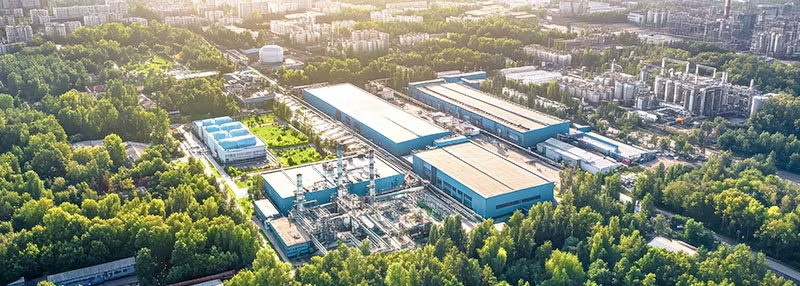
Shandong No.7 Construction Engineering Co., Ltd. هي مؤسسة بناء حديثة واسعة النطاق تدمج البحث والتطوير والتصميم والإنتاج والبناء والتعاقد العام على الهياكل الفولاذية، وتغطي أعمالها الأسواق المحلية والدولية.